
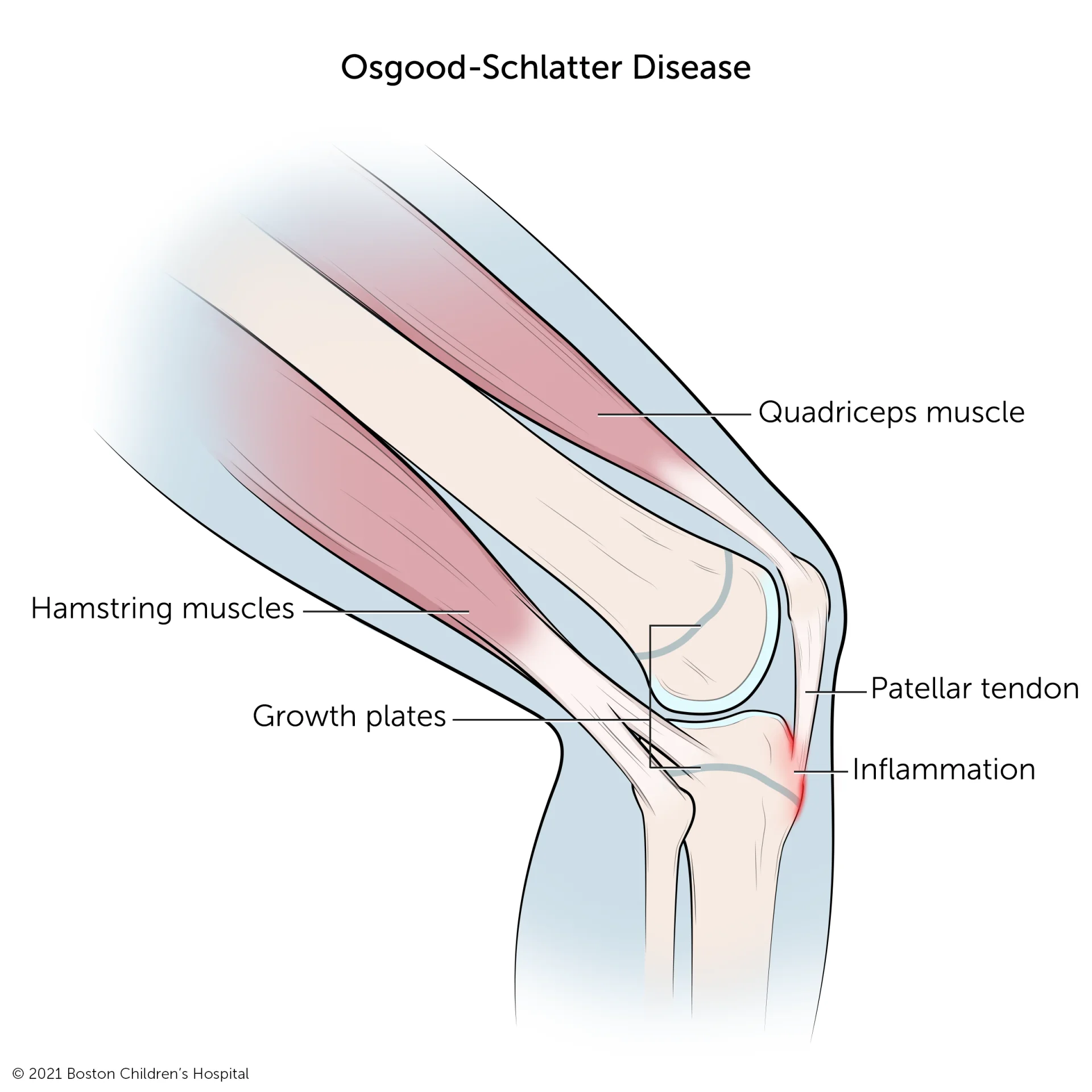
If your son or daughter has been complaining about knee pain, especially right below the kneecap, there's a good chance you've already heard the term Osgood-Schlatter disease. It sounds more alarming than it usually is, but that doesn't mean you should ignore it. Understanding what's happening in that growing knee, and what to do about it, can make a real difference in how quickly your athlete recovers and whether they can keep playing the sport they love.
What Is Osgood-Schlatter Disease?
Osgood-Schlatter is a condition that affects the growth plate just below the knee, at a bony bump called the tibial tuberosity. During a growth spurt, that area is especially vulnerable. Every time the quadriceps (the big muscles on the front of the thigh) contract hard, they pull on the patellar tendon, which attaches right at that spot. When a young athlete is training heavily while also growing quickly, repeated stress can cause irritation and even small avulsion injuries at the growth plate.
It's most common in kids between the ages of 10 and 15, and it tends to show up in sports that involve a lot of running, jumping, and cutting, like soccer, basketball, volleyball, and track. Boys are affected more often than girls, though the gap has narrowed as girls' sport participation has grown.
Managing the Load: The Most Important Step
The single biggest lever you have is activity load. Osgood-Schlatter is essentially an overuse injury in a vulnerable structure, so continuing to pile on the same volume of training without modification is usually what keeps it from healing.
That does not automatically mean complete rest. For most kids, a smarter approach is relative rest, meaning you dial back the intensity and volume to a level that keeps symptoms manageable, then gradually build back up. Here's a simple way to think about it:
- Pain during activity that is mild (a 3 out of 10 or less) and settles within a couple of hours afterward is generally acceptable to train through, with modifications.
- Pain above that level, or pain that lingers the next morning, is a signal to back off further.
- Progress should be gradual, adding no more than about 10 percent volume per week once symptoms are under control.
Strengthening the quadriceps, hamstrings, and hip stabilizers in a pain-free range is a core part of rehabilitation. Weak hips in particular contribute to poor knee mechanics, which puts more stress on exactly the spot that's already irritated.
Red Flags: When to Take It More Seriously
Osgood-Schlatter is typically a self-limiting condition that resolves once a young person stops growing. That said, some situations warrant closer attention:
- Severe pain that makes weight-bearing difficult or impossible
- Significant swelling in the joint itself (not just at the tibial tuberosity bump)
- Pain at night that isn't related to activity
- No improvement after 6 to 8 weeks of appropriate management
- Locking, giving way, or catching sensations in the knee
These signs can point to something other than Osgood-Schlatter, including a fracture, a different growth plate condition, or an internal knee problem. In those cases, you want an evaluation sooner rather than later.
When Is Imaging Needed?
Honestly, most straightforward cases of Osgood-Schlatter are diagnosed clinically, meaning by the history and a hands-on examination, without any imaging at all. An X-ray may be ordered to rule out a fracture or to look at the growth plate if the presentation is atypical, if there was a specific traumatic event, or if the symptoms aren't responding the way you'd expect. MRI is reserved for situations where there's suspicion of a more significant soft tissue injury or when the diagnosis is genuinely unclear.
If your child has a classic presentation (adolescent, active, tenderness right at the tibial tuberosity, pain with activity), imaging is often not the first step.
Treatment Approaches That Actually Help
At our practice, we use a combination of approaches depending on how the individual case presents. Here's a look at what tends to be most useful:
Manual Therapy
Tight quadriceps and hip flexors dramatically increase the pull on the patellar tendon. Soft tissue work and manual therapy directed at those areas can take meaningful load off the irritated growth plate. We also look at how the whole lower kinetic chain is moving, because sometimes what's happening at the hip or ankle is contributing to the problem at the knee.
Class IV Laser Therapy
Low-level laser therapy (sometimes called photobiomodulation) has good evidence for reducing pain and promoting tissue healing in tendinopathies and growth plate irritation. It's painless, quick, and well-tolerated by kids. We use it regularly for Osgood-Schlatter because it can help calm down the localized inflammation and support healing without adding any stress to the area.
Patellar Taping and Bracing
Taping techniques, particularly patellar tendon straps, can offload some of the stress at the tibial tuberosity during activity. For a lot of young athletes, this is what allows them to keep participating in their sport at a reduced level while the rehabilitation progresses. It's not a cure on its own, but it's a useful tool in the toolkit.
Exercise Rehabilitation
Progressive loading of the quadriceps, once pain allows, is actually part of the treatment, not just a return-to-sport goal. Isometric exercises (holding a position without moving) are often a good starting point because they strengthen the muscle without the tendon irritation that eccentric loading can cause early on.
To learn more about the services we offer for young athletes and sports-related injuries, visit our services page.
A Note to Parents
It can be hard to watch your kid sit out, especially when they're passionate about their sport and have games or tryouts coming up. The honest reality is that pushing through without a plan often extends the problem rather than shortening it. Getting a proper evaluation and building a clear return-to-play strategy is almost always faster in the long run than grinding through and hoping it resolves on its own.
If your child is dealing with knee pain and you're not sure what to do next, we're happy to take a look and talk through the options with you. You can reach out through our contact page to get started.